Recently, Researcher Di Zhang and Assistant Researcher Xuejun Wang from the team of Professor Xingang Li at Jinan Microecological Biomedicine Shandong Laboratory constructed a near-infrared light-responsive engineered probiotic system, which regulates the production and release of γ-aminobutyric acid (GABA) through photothermal conversion. The system alleviates anxiety-like behaviors in a mouse model of repeated restraint stress, offering a new strategy for intervening in emotional disorders based on the gut-brain axis. This study, entitled “A light-responsive engineered probiotic system to alleviate anxiety via gut-brain axis”, was published in Frontiers in Bioengineering and Biotechnology on October 8, 2026. Yuling Chang, a postgraduate student jointly trained by Jinan Microecological Biomedicine Shandong Laboratory and Shandong First Medical University, is the first author of the paper. Jinan Microecological Biomedicine Shandong Laboratory and Shandong First Medical University serve as co-first affiliations.
Anxiety disorders severely impair patients’ quality of life, and existing interventions still face challenges including variable individual treatment responses and long treatment cycles. The gut-brain axis connects the gastrointestinal tract and the central nervous system, participating in emotion regulation via neural, immune and metabolic pathways, and represents a promising direction for developing interventions for anxiety-related disorders. GABA is an inhibitory neurotransmitter closely associated with emotion regulation. Gut microbiota-derived GABA may modulate brain function through peripheral neural and immune pathways. Major challenges for this therapeutic strategy include enabling engineered probiotics to withstand the harsh gastrointestinal environment, prolonging intestinal retention, and achieving controllable release of functional molecules.
To address these challenges, the research team adopted Escherichia coli Nissle 1917 (EcN) as the chassis strain, equipped it with a thermally regulated GABA synthesis module, coated the bacterial surface with polydopamine (pDA), and further conjugated the small-intestine-targeting peptide pepT1 to construct the engineered probiotic system EcN-Gadabc@pDA-pepT1. Integrating thermogenetic regulation, photothermal conversion and intestinal targeted delivery, this system converts external near-infrared light stimulation into thermal signals to tune the functional output of engineered bacteria.
During system construction and functional validation, transmission electron microscopy, particle size analysis and zeta potential characterization confirmed successful polydopamine coating on bacterial surfaces. Near-infrared irradiation elevated the temperature of the coated bacterial suspension, and stable photothermal responsiveness was maintained over multiple cycles of irradiation and cooling. Further experiments demonstrated that light exposure enhanced reporter gene expression and GABA production. Meanwhile, polydopamine coating improved bacterial survival in simulated gastric fluid, intestinal fluid and bile salt environments. Modification with pepT1 further strengthened the adhesion of engineered bacteria to the small intestinal mucosa and extended intestinal retention; strong bioluminescent signals were still detectable 8 hours after oral administration, laying a delivery foundation for their in-situ function in the gut.
For in vivo functional evaluation, the team established a repeated restraint stress mouse model and assessed anxiety-like behaviors using the elevated plus maze, open field test and light-dark box test. Compared with the control strain group, engineered probiotics combined with near-infrared irradiation prolonged the time mice spent in the open arms of the elevated plus maze, increased the frequency of entries into the central zone in the open field test and the number of exploratory entries into the light compartment in the light-dark box test. Collectively, these behavioral results demonstrated that this system ameliorates anxiety-like behaviors in stressed mice.
To explore the underlying mechanism, the team further performed gut microbiota profiling, serum proinflammatory cytokine detection and brain tissue immunofluorescence analysis. The results showed that intervention with the engineered probiotics reshaped the gut microbiota composition and reduced the relative abundance of Clostridium. In addition, serum levels of proinflammatory cytokines IL-1β, IL-6 and TNF-α decreased, while the level of anti-inflammatory cytokine IL-10 increased. Detection of neuronal activity markers revealed a reduction in c-fos-positive neurons across multiple subregions of the amygdala, accompanied by altered neuronal activity markers in the nucleus tractus solitarius and locus coeruleus. These findings suggest that the anxiolytic effect of the system may arise from coordinated changes in gut microecology, peripheral inflammatory status and activity of emotion-related brain regions.
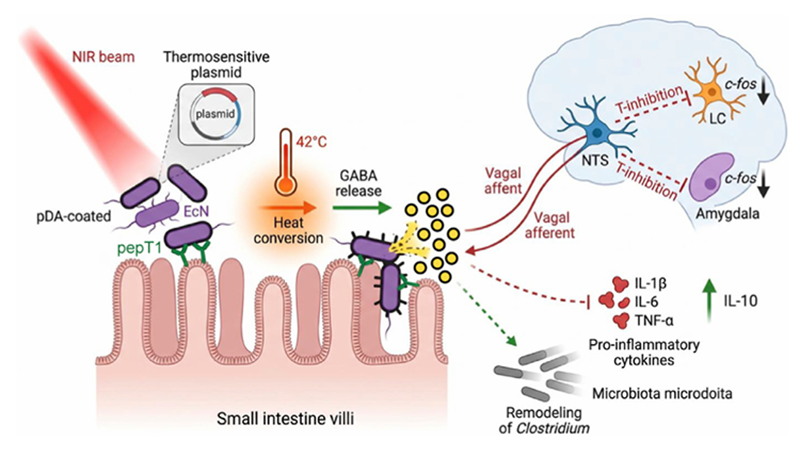
Schematic diagram illustrating the mechanism by which EcN-Gadabc@pDA-pepT1 regulates anxiety-like behaviors via the gut-brain axis
Research Insights
Combining synthetic biology with functional materials, this study provides an integrated design strategy for oral protection, intestinal delivery and externally controllable functional output of engineered probiotics, and offers preclinical evidence for modulating emotion-related behaviors through the gut-brain axis. Further studies are warranted to verify the causal relationships of key neural circuits, evaluate long-term safety and test additional preclinical models to support the optimization and translational development of this strategy.
Researcher Di Zhang and Assistant Researcher Xuejun Wang from Jinan Microecological Biomedicine Shandong Laboratory are the co-corresponding authors of this paper. This research was supported by the Key Research and Development Program of Shandong Province (2025CXPT177), the Research Fund of Jinan Microecological Biomedicine Shandong Laboratory (JNL-2025006B) and the Natural Science Foundation of Shandong Province (ZR2023QH322).