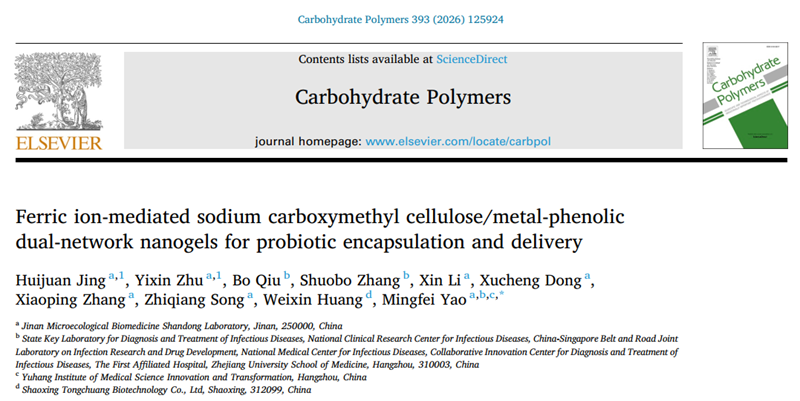
A team led by Associate Researcher Yao Mingfei and Assistant Researcher Jing Huijuan from Jinan Microecological Biomedicine Shandong Laboratory has developed a ferric ion-mediated sodium carboxymethyl cellulose/metal-phenolic dual-network nanogel system for probiotic delivery. By integrating the nanogel matrix with metal-phenolic networks, this strategy enables precise encapsulation of probiotics at the single-cell level and endows the delivery system with synergistic multifunctional properties. The related research article entitled Ferric ion-mediated sodium carboxymethyl cellulose/metal-phenolic dual-network nanogels for probiotic encapsulation and delivery has been published in Carbohydrate Polymers. Jing Huijuan, Assistant Researcher at Jinan Microecological Biomedicine Shandong Laboratory, is the first author of this paper. Zhu Yixin, Assistant Experimentalist, is the co-first author. Jinan Microecological Biomedicine Shandong Laboratory is the first affiliation.
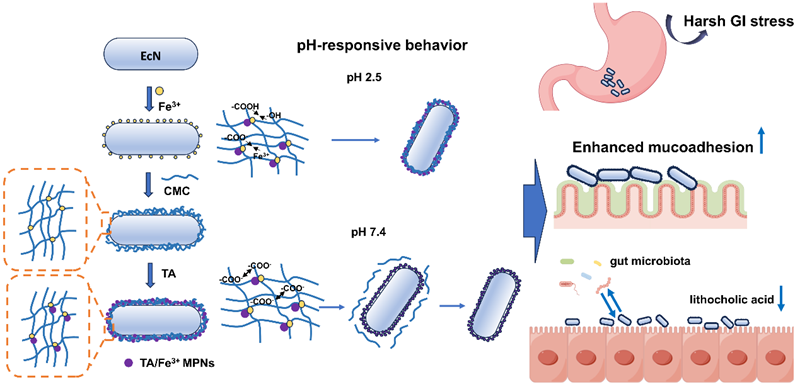
The major practical challenge for the oral administration of probiotics is that bacterial cells are readily inactivated under the strongly acidic environment of the stomach and difficult to adhere to and colonize in the intestinal tract. Conventional encapsulation techniques often suffer from poor coating stability, limited protective capacity and weak mucoadhesive performance. To address these bottlenecks, the team innovatively adopted ferric ions (Fe³⁺) as crosslinking mediators. Through self-assembly, a pH-responsive sodium carboxymethyl cellulose (CMC) gel network and metal-phenolic network (tannic acid (TA)/Fe³⁺ MPNs) were constructed on the surface of Escherichia coli Nissle 1917 (EcN) probiotic cells. The two networks work synergistically for protection and targeted delivery. The whole encapsulation process is carried out under mild conditions without impairing the viability of probiotics, and the carrier materials exhibit favourable biosafety.
Studies verify that the constructed CMC/MPNs dual-network structure possesses distinctive pH-responsive behaviours. In gastric acid, the CMC gel layer shrinks and densifies to form a physical barrier for the encapsulated bacteria, while the MPN structure remains stable against acid. After entering the intestinal environment, the CMC layer gradually dissociates and exposes the functional MPN layer. In vitro simulated digestion experiments demonstrate that probiotics encapsulated by this system achieve a markedly higher viable count after gastric fluid stress treatment and retain excellent survival and proliferation capacity in intestinal fluid. Benefiting from abundant phenolic hydroxyl groups of tannic acid, MPNs can bind to intestinal mucin via multiple noncovalent interactions including hydrogen bonding and hydrophobic interactions. In in vitro cell models, the adhesion rate of encapsulated probiotics is greatly improved. In vivo animal imaging further confirms that dual-network coating can significantly prolong the gastrointestinal retention time of probiotics in mice. Moreover, the system exhibits free radical scavenging antioxidant activity, and cytotoxicity assays show that the carrier has no obvious toxic effect on intestinal epithelial cells.
Analysis of the gut microbiome reveals that compared with oral administration of free probiotics, probiotics delivered via the dual-network system can more effectively modulate the host gut microbiota structure, upregulate the abundance of beneficial taxa, and exert broader metabolic regulatory effects than free probiotics.
Research Insights
This ferric ion-mediated dual-network nanogel ingeniously combines the respective advantages of polysaccharide hydrogels and metal-phenolic networks, integrating acid resistance protection, intestinal adhesion and antioxidant functions. It provides a new technical route for efficient probiotic delivery in fields such as functional foods and gastrointestinal disease intervention.
Associate Researcher Yao Mingfei is the corresponding author of this paper. This work was supported by the National Key Research and Development Program of China (2022YFA1303800), the Natural Science Foundation of Shandong Province (ZR2024QC139), the Taishan Scholars Program (tsqnz20231241, tsqn202408310), and research grants from Jinan Microecological Biomedicine Shandong Laboratory (JNL-2023003Q, JNL-2025012B).