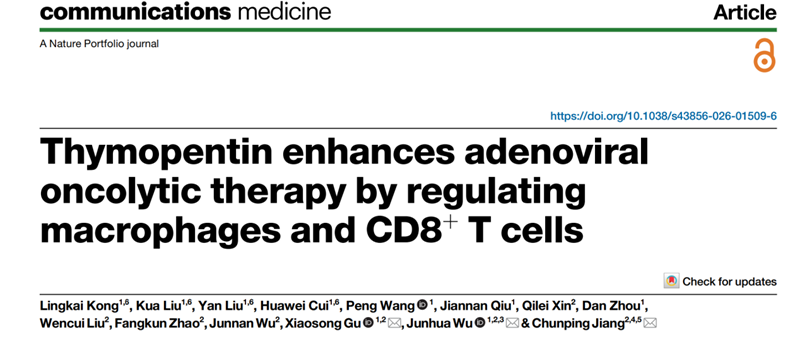
The team led by Academician Gu Xiaosong, Professor Jiang Chunping (Deputy Director of the Laboratory) and Principal Investigator Professor Wu Junhua at Jinan Laboratory has discovered that the combined administration of thymopentin (TP5) and adenovirus (ADV) can reprogram the tumor microenvironment, increase the tumor infiltration of pro-inflammatory macrophages and CD8⁺ T cells, markedly improve anti-tumor efficacy, and induce long-term immune memory in the body. The research paper, entitled Thymopentin enhances adenoviral oncolytic therapy by regulating macrophages and CD8+ T cells, was published in Communications Medicine (Q1 journal, IF=7.4). Kong Lingkai, Liu Kua, Liu Yan and Cui Huawei from the State Key Laboratory of Pharmaceutical Biotechnology, Nanjing University are the co-first authors of the paper, and Jinan Provincial Laboratory of Microecology and Biomedical Sciences serves as the first corresponding author institution.
Cancer remains a major global public health challenge. As an emerging tumor therapeutic modality, immunotherapy has attracted extensive attention. It mainly relies on the body’s own immune system to recognize and kill tumor cells, featuring excellent specificity and durability. Drugs represented by immune checkpoint inhibitors have achieved remarkable therapeutic effects in the treatment of multiple malignant tumors. Nevertheless, some patients still fail to respond to treatment or suffer tumor recurrence. Oncolytic viruses (OVs) can specifically infect, replicate within and lyse tumor cells without damaging normal cells, representing a highly promising technical direction for solid tumor therapy. At present, most oncolytic virus therapies are combined with at least one other therapeutic modality or anti-tumor drug, such as combination with CTLA-4 antibodies, or introduction of immunostimulatory molecules into the tumor microenvironment (TME) via gene editing to further amplify anti-tumor effects.
Thymopentin (TP5) is a synthetic pentapeptide corresponding to amino acid residues 32–36 of thymopoietin II (Arg-Lys-Asp-Val-Tyr). With favorable immunomodulatory activity and low cytotoxicity, TP5 has been clinically applied as adjuvant therapy for patients with immunodeficiency diseases, malignant tumors and infectious diseases. Multiple studies have confirmed that TP5 can bind to T cell-specific receptors, elevate intracellular cAMP and GMP levels, promote T cell differentiation, and subsequently trigger a series of intracellular signaling responses to regulate immune function. Against this background, TP5, a clinically approved immunomodulator, is expected to be an ideal combinatorial drug to boost the anti-tumor efficacy of oncolytic viruses.
In this study, multiple mouse models were used to verify that the combination of adenovirus (ADV) and thymopentin (TP5) confers potent anti-tumor effects. Compared with control groups, the ADV+TP5 combinatorial regimen achieved significantly improved anti-tumor efficacy. In the H22 tumor model, this combination even enabled complete tumor regression and induced tumor-specific immune memory. To maximize the anti-tumor effect of ADV combined with TP5 while reducing the medication burden caused by frequent administration, the research team constructed a recombinant adenovirus ADV-TP5 capable of expressing TP5 (RKDVY). This recombinant virus fully recapitulated all anti-tumor advantages of the combined administration of ADV and TP5 drugs. Results of cellular antibody depletion experiments demonstrated that depletion of macrophages, CD8⁺ T cells, or both cell populations attenuated the therapeutic effect of ADV-TP5. These two immune cells exert complementary functions in anti-tumor immunity rather than acting completely independently; knocking out either cell type alone is sufficient to significantly disrupt the overall therapeutic mechanism. Flow cytometry assays revealed that ADV-TP5 can effectively reprogram tumor-associated macrophages, activate CD8⁺ T cells, enhance the anti-tumor activity of T cells, and remodel the tumor microenvironment into a state more conducive to anti-tumor immunity.
ADV-TP5 exhibited robust anti-tumor activity in PBMC-humanized CDX models (triple-negative breast cancer, hepatocellular carcinoma) and PBMC-humanized PDX model (triple-negative breast cancer), fully demonstrating the clinical translational potential of this regimen. Notably, the potentiating effect of TP5 on oncolytic viruses is not limited to adenovirus. When combined with various oncolytic viruses including herpes simplex virus (HSV) and vaccinia virus (VV), TP5 can also induce effective anti-tumor immune responses.
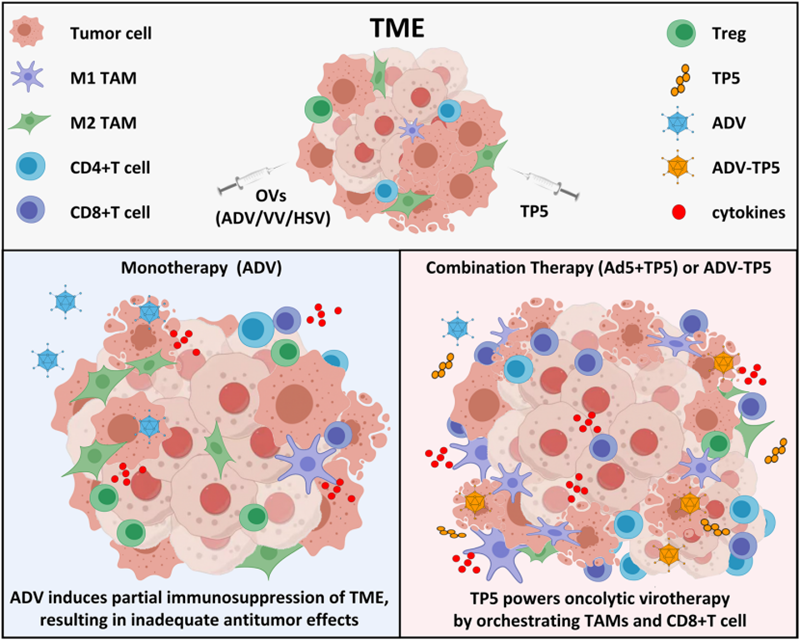
Figure: Schematic diagram illustrating the mechanism by which TP5 enhances oncolytic virus therapy via regulation of tumor-associated macrophages (TAMs) and CD8⁺ T cells
Research Insights: Since TP5 is an immunomodulator approved for clinical use in many countries worldwide, this study provides a highly clinically translatable new strategy for combined oncolytic virus therapy, and develops a promising recombinant oncolytic adenovirus for tumor treatment.
Professor Jiang Chunping, Professor Wu Junhua and Academician Gu Xiaosong of Jinan Provincial Laboratory of Microecology and Biomedical Sciences are the co-corresponding authors of this paper. This research was supported by the Key Research and Development Program of Shandong Province (2025CXPT176), the Natural Science Foundation of Shandong Province (ZR2025MS1306), the National Natural Science Foundation of China (81972888, 82272819), research projects of Jinan Provincial Laboratory of Microecology and Biomedical Sciences (JNL-2025008B, JNL-2025009B, JNL-2025011B, JNL-2025010B, JNL-2025012B, JNL-2023017D), the Shandong Provincial Laboratory Project (SYS202202), and the Key Research and Development Program of Jiangsu Province (BE2022840).