The research team led by Professor Nanping Wu, Deputy Director-General of Jinan Laboratory, screened a commensal bacterial strain Escherichia coli JNL-EC1 from the gut of infants and young children that can promote the expression of type I interferon (IFN-I). The team revealed that metabolites of this strain boost the phosphorylation of STING, TBK1 and IRF3 proteins, activate the cGAS-STING signaling pathway, and significantly inhibit herpes simplex virus type 1 (HSV-1) and vesicular stomatitis virus (VSV). This study, entitled Escherichia coli JNL-EC1 enhances type I IFN-mediated antiviral response during DNA and RNA virus infection, was published in Frontiers in Microbiology. Rui Li, a joint-training master’s student of Jinan Provincial Laboratory of Microecology and Biomedicine and Shandong First Medical University, is the first author of the paper. Jinan Provincial Laboratory of Microecology and Biomedicine serves as the primary corresponding author institution.
Infants and young children are at extremely high risk of viral infection due to the immature development of their immune system, especially adaptive immunity. Meanwhile, their liver and kidney functions are limited, and most conventional antiviral drugs are not suitable for use due to safety concerns. Therefore, screening commensal bacteria from the intestinal tract of infants and young children that can promote type I interferon (IFN-I) expression and elucidating their antiviral mechanisms carries important clinical and scientific value for developing safe and effective microecological antiviral intervention strategies.
The research team first isolated and identified 45 intestinal bacterial strains from faecal samples of infants and young children aged 0–3 years. A screening platform was used to systematically evaluate the effects of each strain on Sendai virus (SeV) infection-induced IFN-I expression. For the first time, an Escherichia coli strain numbered JNL-EC1 was found to significantly enhance SeV- and herpes simplex virus type 1 (HSV-1)-induced activation of the IFN-I signaling pathway. The team performed whole-genome sequencing, phylogenetic analysis and virulence gene profiling of this strain. The results confirmed that it has no typical pathogenicity (no hemolytic activity and lacks major virulence factors such as Shiga toxin, heat-labile enterotoxin and heat-stable enterotoxin), consistent with the characteristics of commensal bacteria or low-virulence strains.
Subsequent findings showed that metabolites of JNL-EC1 can synergistically enhance cGAS-STING pathway-mediated activation of IFN-I signaling and markedly increase the phosphorylation levels of STING, TBK1 and IRF3 proteins. The metabolites also promote RNA virus infection-triggered IFN-I signaling activation, yet exert no further enhancing effect on downstream gene expression driven by overexpression of IRF3-5D (constitutively active mutant), indicating that its site of action is upstream of IRF3.
In functional validation experiments, pretreatment with JNL-EC1 metabolites significantly inhibited the replication of HSV-1 and VSV (vesicular stomatitis virus) in cells. This inhibitory effect was prominent in THP-1 cells (with intact cGAS-STING pathway), whereas the inhibitory effect on HSV-1 disappeared in INT407 cells (with defective cGAS-STING function). These data confirmed that the anti-DNA virus effect of this strain relies on the cGAS-STING pathway. In in vivo experiments, in a SeV-infected mouse model administered live JNL-EC1 bacteria via gavage, the expression of Ifnb1 mRNA in the spleen was upregulated. Analysis of immune cell subsets revealed increased proportions of dendritic cells (DCs), CD4⁺ T cells and CD8⁺ T cells in the spleen, demonstrating that JNL-EC1 can systematically regulate the host antiviral immune cell network through intestinal colonization.
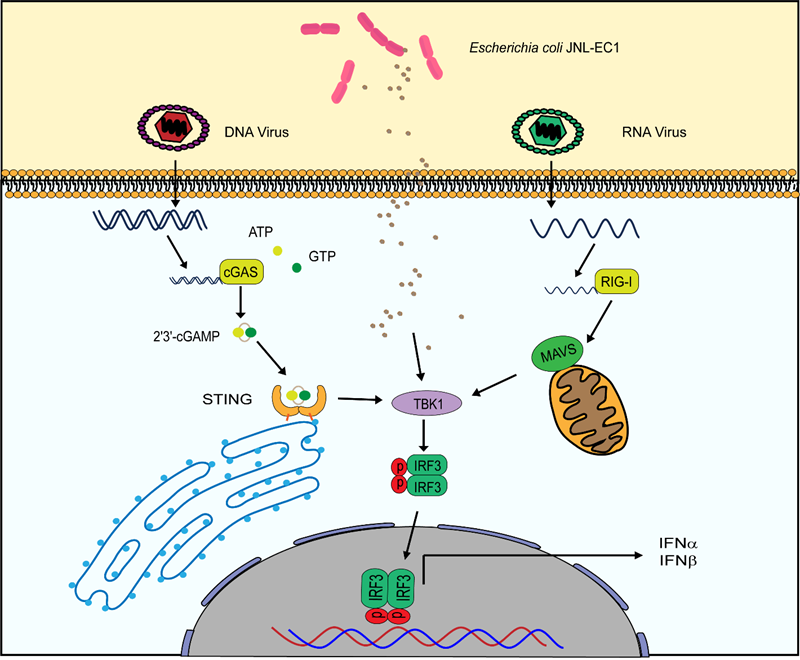
Mechanism underlying the antiviral effects of Escherichia coli JNL-EC1
Research insights: This study provides important inspiration for mining antiviral functional strains from the intestinal microecology of infants and young children. Functional screening based on key pathways of host innate immunity represents an effective approach to discover commensal bacteria with immunomodulatory potential. Meanwhile, the findings suggest that the large group of so-called “non-probiotic” taxa in the gut may harbour unrecognised positive immunomodulatory functions, which deserve re-evaluation by breaking the traditional binary framework of “probiotics versus pathogens”. This study also indicates that translation from basic discovery to clinical application requires further identification of active components, dose optimisation, long-term in vivo safety assessment and verification of broad-spectrum activity against multiple viruses.
Nanping Wu, Zhaoyi Pan and Haibo Wu of Jinan Provincial Laboratory of Microecology and Biomedicine are co-corresponding authors of this paper. This work was supported by the Shandong Laboratory Project (SYS202202), Shandong Natural Science Foundation (ZR2023QH546, ZR2023QH494, ZR2023LZY003), Research Projects of Jinan Provincial Laboratory of Microecology and Biomedicine (JNL-2022004Q, JNL-2023014D, JNL-2025005B) and the National Key Research and Development Program of China (2023YFC2506004).