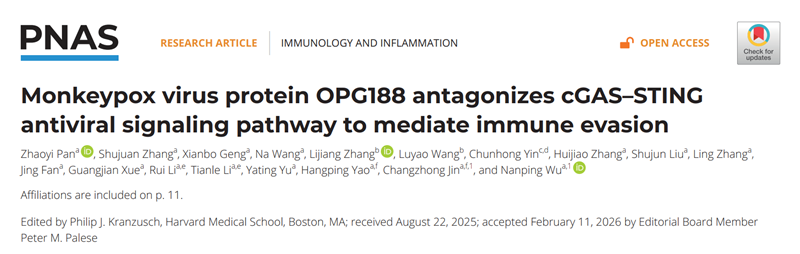
Dr Pan Zhaoyi and Professor Wu Nanping’s team, Executive Deputy Director of the Jinan Microecological Biomedicine Shandong Laboratory , has made significant progress in research into how monkeypox virus antagonises innate immunity. The findings, titled “Monkeypox virus protein OPG188 antagonises cGAS-STING antiviral signalling pathway to mediate immune evasion”, were published online in *PNAS* on 19 March 2026. The team reported that OPG188, a key virulence protein of the monkeypox virus, antagonises the cGAS-STING antiviral signalling pathway to achieve immune evasion. This study not only reveals the mechanism by which the monkeypox virus evades antiviral immunity but also provides a novel target for the development of targeted antiviral drugs.Jinan Microecological Biomedicine Shandong Laboratory is the lead institution for this paper.
The global spread of monkeypox virus (MPXV) poses a serious public health threat. A survey published in *JAMA* in November 2024 revealed that between July 2022 and May 2023 alone, over 99,000 people in 118 countries were infected with MPXV. Consequently, on 14 August 2024, the World Health Organisation declared the monkeypox outbreak a ‘Public Health Emergency of International Concern’ for the second time. The cGAS-STING pathway serves as the body’s first line of defence against DNA viral invasion. When viral DNA enters the cytoplasm, the sensor cGAS utilises ATP and GTP to synthesise the second messenger 2'3'-cGAMP. This molecule activates the STING protein on the endoplasmic reticulum, which in turn recruits the TBK1 kinase to phosphorylate the transcription factor IRF3, ultimately initiating the expression of type I interferon (IFN-I) and downstream antiviral genes. However, as a cytoplasmically replicating DNA virus, MPXV has evolved multiple strategies to evade immune surveillance. Previous studies have revealed little about the specific molecular mechanisms by which MPXV suppresses the cGAS-STING pathway, which has become a bottleneck in vaccine and drug development.
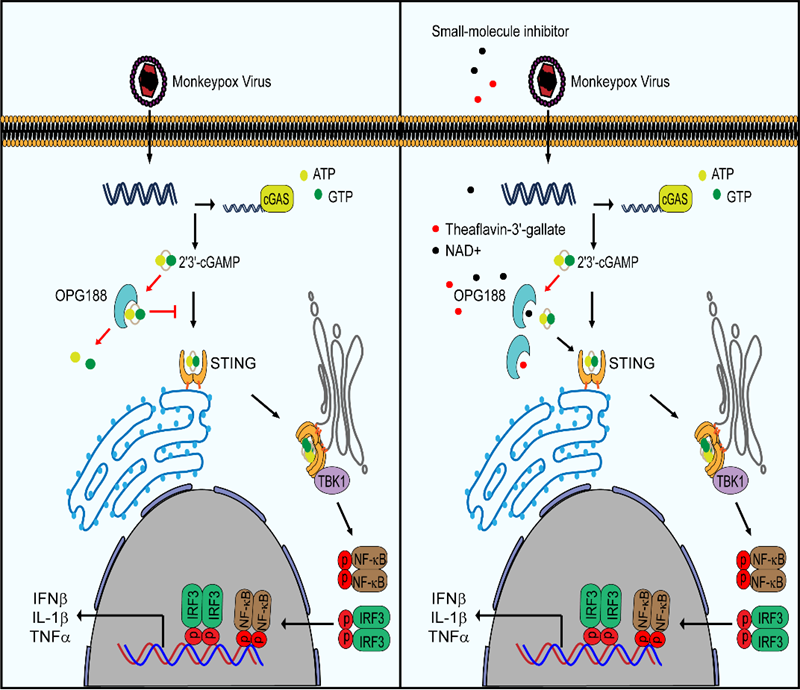
Schematic diagram of the mechanism by which monkeypox virus OPG188 antagonises the cGAS-STING pathway
To unravel this mystery, the research team constructed an expression library comprising all 179 genes of the MPXV genome and systematically screened HEK293T cells for viral proteins capable of inhibiting cGAS-STING-driven activation of the IFN-β promoter. The results precisely identified three key culprits: OPG147, OPG188 and OPG200. In particular, by investigating the mechanism by which OPG188 exerts its function, the research team discovered that OPG188 can efficiently degrade 2′3′-cGAMP in vitro, leading to a decrease in intracellular 2′3′-cGAMP levels. This blocks the transport of STING from the endoplasmic reticulum to the Golgi apparatus, thereby disrupting the downstream signalling cascade.
Based on the three-dimensional structure of the OPG188 catalytic pocket, the team conducted a large-scale virtual screening: molecular docking and high-throughput validation were performed on a total of 7,155 small molecules, comprising 2,858 from the FDA library and 4,279 from the TargetMol library. Two compounds that stood out—NAD⁺ (β-nicotinamide adenine dinucleotide) and theaflavin-3′-gallate (TF2B)—competitively bind to the Poxin active pocket, significantly inhibiting the nucleolytic activity of OPG188. In the future, by optimising the structures of these compounds, it is hoped that highly effective drugs against monkeypox virus infection can be developed.
Scientific Implications: In future research, the team will utilise the drug screening platform to identify small-molecule drugs targeting OPG188 and other viral targets, whilst simultaneously optimising the structures of the selected compounds. This holds significant importance for the subsequent development of antiviral drugs and the prevention and control of viral epidemics.
This study was supported by the Shandong Natural Science Foundation (ZR2023QH546, ZR2023QH494, ZR2023LZY003), the Jinan Microecological Biomedicine Shandong Laboratory (JNL-2022004Q, JNL-2025005B), the National Key Research and Development Programme (2023YFC2506004), the Zhejiang Province Applied Basic Research (Leading Goose) Programme (2024C03218) and the Shandong Provincial Laboratory Programme (SYS202202)
In recent years, Pan Zhaoyi, as principal investigator, has undertaken research projects including the Jinan Laboratory PhD Start-up Fund, the Laboratory Youth Fund and the Shandong Provincial Natural Science Foundation Youth Project; he has published over 10 SCI-indexed papers, including four as first author in journals such as *PNAS* and *Virulence*; and has been granted one invention patent and one utility model patent.