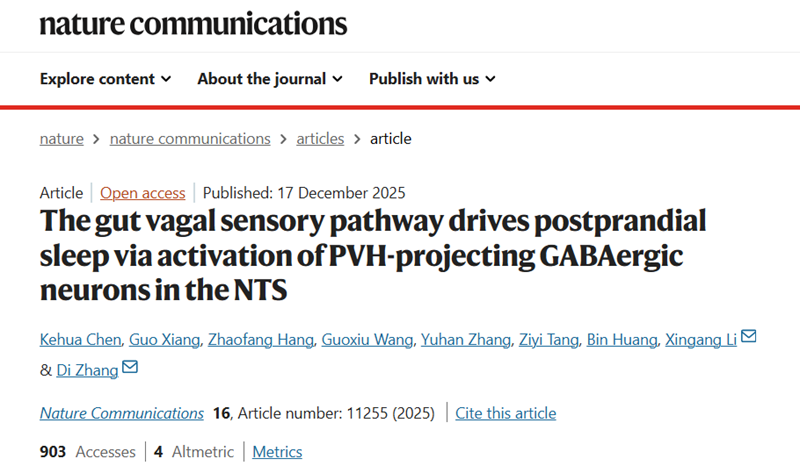
Professor Li Xingang, Deputy Director of the Jinan Microecological Biomedicine Shandong Laboratory, and Principal Investigator Zhang Di's research team focused on the circuit mechanisms of the vagus nerve regulating central nervous system functions within the direct neural pathways of the gut-brain axis. They investigated the regulatory role of this nerve in sleep and its central circuit mechanisms, revealing its crucial function in the occurrence of the ‘food-induced drowsiness’ phenomenon. On 17 December 2025, this research was published in Nature Communications under the title ‘The gut vagal sensory pathway drives postprandial sleep via activation of PVH-projecting GABAergic neurons in the NTS’.
The study discovered that following food intake in mice, vagal sensory neurons innervating the stomach and duodenum become activated. While transmitting satiety signals to the brain, they simultaneously inhibit wakefulness via an independent circuit, inducing postprandial sleepiness. Building upon the common phenomenon of postprandial somnolence, this neuroscience study employed a combination of techniques including trans-synaptic viral tracing, single-nucleus RNA sequencing, and optogenetic/chemogenetic manipulation. It uncovered the pivotal role of vagal sensory neurons innervating the upper digestive tract in regulating sleep-wake states and promoting postprandial sleep, elucidating the neural circuit mechanism driving this phenomenon.
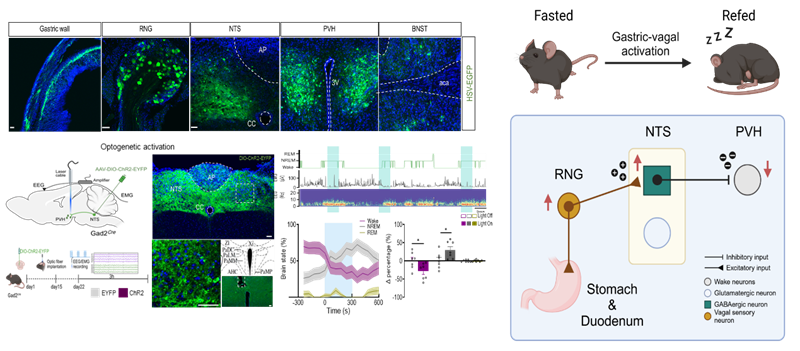
Results demonstrate that both feeding and chemogenetic activation of vagal sensory neurons innervating the stomach/duodenum suppress wakefulness and increase non-rapid eye movement sleep in mice. Conversely, chemogenetic inhibition eliminates feeding-induced ‘postprandial somnolence’. Further investigations revealed that vagal sensory neurons from the stomach/duodenum reduce arousal levels by activating GABAergic neurons in the nucleus of the solitary tract (NOST). Circuit analysis demonstrated that NOST GABAergic neurons projecting to the paraventricular nucleus of the hypothalamus participate in vagal regulation of sleep-wake states. This study clarifies the crucial role of vagal sensory input from the upper gastrointestinal tract in sleep-wake regulation. It identifies an ascending pathway—‘stomach/duodenum → vagal ganglion → solitary nucleus GABAergic neurons → hypothalamic paraventricular nucleus’—and reveals its key role in integrating feeding behaviour with sleep.
Scientific Implications: This study commenced from the most direct gut-brain neural pathway—the vagal sensory outflow—combining neuroscientific techniques including transsynaptic viral tracing, single-nucleus RNA sequencing, and optogenetic/chemogenetic manipulation. It uncovered the sleep-promoting effect of activating the vagal sensory branch in the digestive tract and elucidated the neural circuit mechanism underlying the common phenomenon of ‘postprandial somnolence’. This research identifies a universally applicable neural circuit regulating sleep, offering novel intervention perspectives for sleep disorders (such as insomnia and hypersomnia) and sleep disturbances caused by metabolic diseases. Precise modulation of this pathway holds promise for developing novel therapeutic strategies targeting sleep disorders.
Professor Li Xingang and Research Fellow Zhang Di served as co-corresponding authors, with postgraduate student Chen Kehua as first author. This work was supported by the National Natural Science Foundation of China (82071512), the Shandong Natural Science Foundation (ZR2019ZD33), and the Shandong Provincial Laboratory Programme (SYS202202).